
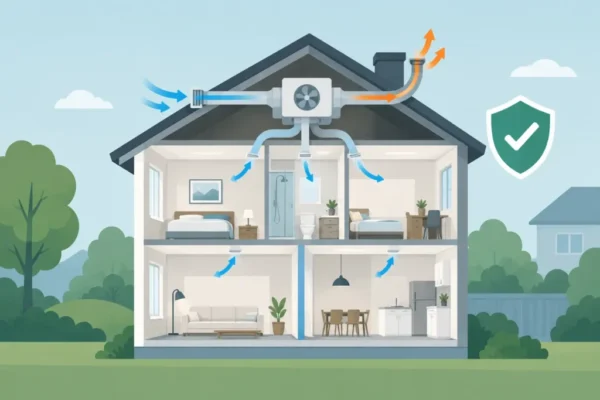
A bathroom that stays steamy long after a shower, a dryer that needs two cycles, or a kitchen that holds onto cooking odors can be more than a household annoyance. These are often signs that air is not moving where it should. Understanding home ventilation code basics helps homeowners recognize when a vent system is designed for safe performance and when it may need professional attention.
Ventilation requirements are not just about comfort. They help control moisture, reduce indoor pollutants, protect building materials, and move combustion byproducts and humid air out of the home. Dryer vent requirements also play a direct role in reducing fire risk. The exact rules depend on your local building department and the code adopted in your area, but the principles behind them are consistent.
What Home Ventilation Codes Are Designed to Do
Residential ventilation codes set minimum standards for how air is brought into, moved through, and exhausted from a home. They generally address whole-home ventilation, bathroom exhaust, kitchen exhaust, dryer venting, duct materials, fan capacity, termination locations, and access for maintenance.
The goal is not to make every house feel drafty. It is to ensure that stale, humid, or contaminated air has a reliable path out, while fresh air can replace it in a controlled way. Tightly built homes can be more energy efficient, but they also need intentional ventilation. Without it, moisture and pollutants can build up indoors.
Local codes matter because climate, housing types, and municipal rules vary. Your area may use a version of the International Residential Code, the International Mechanical Code, or a locally amended standard. A contractor should verify the current local requirement before installing or altering a vent system. Manufacturer instructions matter, too. If an appliance manufacturer calls for a more restrictive installation method than the general code, the manufacturer instruction usually governs.
Home Ventilation Code Basics: Exhaust Must Go Outdoors
One of the clearest rules in residential ventilation is that exhaust air must be discharged outdoors. That includes dryer exhaust and, in most cases, bathroom and kitchen exhaust. Sending humid air into an attic, crawl space, garage, soffit, or wall cavity can create condensation and mold conditions, damage framing, and reduce insulation performance.
A proper exterior termination also needs careful placement. Exhaust should not discharge where it can be pulled back into the home through an opening, interfere with another appliance intake, or create a nuisance near walkways, windows, or neighboring properties. Exact clearance distances vary by appliance type and local code, so this is not a place for guesswork.
Exterior caps should allow air to leave freely while keeping out weather and animals. A blocked, damaged, or poorly installed cap can restrict airflow just as much as a clogged duct. For dryer vents, screens at the termination are generally not appropriate because lint can collect on them quickly. A functioning backdraft damper is typically the safer design.
Dryer Vent Requirements Homeowners Should Know
Dryer vents are often treated like simple ducts, but they carry hot, moisture-laden air and highly combustible lint. A dryer may still run when its vent line is unsafe or restricted, which is why visible performance problems should not be ignored.
Code requirements commonly focus on the duct route, duct material, connections, total length, and exterior termination. Dryer exhaust ducts are generally required to be made from smooth, rigid metal. Flexible plastic or vinyl ducts are a serious concern because they can sag, trap lint, and are not designed for the heat involved. Thin foil transition ducts may be allowed only in limited appliance-to-wall connections, depending on local rules and manufacturer directions, but they are not a substitute for a properly installed permanent vent line.
The route matters as much as the material. Long runs, sharp turns, crushed sections, and unnecessary elbows reduce airflow. Most dryer manufacturers specify a maximum allowed vent length, with deductions for elbows and other fittings. A short, straight run is usually best, but a longer run may be workable when it is properly designed and supported.
Connections should be smooth on the inside of the duct. Fasteners that project into the airflow can catch lint, so taped or properly designed mechanical connections are often preferred over screws that penetrate the duct interior. Duct joints should also be secure and sealed with products suited to venting applications, not ordinary cloth-backed duct tape that can dry out and fail.
Cleaning Does Not Fix a Bad Installation
Professional cleaning removes accumulated lint and restores airflow, but it cannot make an improperly routed, crushed, or unsafe vent line code-compliant. If a technician finds damaged transition ducting, an inaccessible run, excessive length, or a poor exterior termination, repair or replacement may be the more durable solution.
That is why annual dryer vent cleaning is most valuable when it includes a real inspection. The technician should evaluate airflow, the condition of the vent line, connections behind the dryer, and the exterior cap – not simply remove visible lint from one section.
Bathroom Fans Need a Complete Vent Path
Bathroom fans are intended to remove moisture at its source. A fan that is noisy but leaves mirrors fogged and walls damp may be undersized, obstructed, disconnected, or venting into the wrong space.
In many homes, bathrooms without an operable window require mechanical exhaust. Code commonly sets minimum fan capacity based on the room or fixture count, although the required airflow method can vary. Bigger is not automatically better. An oversized fan can be unnecessarily loud or pull conditioned air out of the house too quickly, while an undersized fan will not control moisture effectively.
The duct from the fan to the exterior should be continuous, supported, and routed to reduce airflow resistance. In colder regions, insulation and proper routing help limit condensation inside the duct. Sagging flex duct is a frequent problem because it creates low points where moisture can collect and airflow slows down. If you see staining around a bath fan grille, smell mildew, or notice persistent peeling paint, the vent path deserves inspection.
Whole-Home Ventilation Is Different From Spot Exhaust
Bathroom fans, range hoods, and dryer vents remove air from specific locations. Whole-home ventilation addresses the overall supply of fresh air throughout the house. Depending on the home and local code, this may involve exhaust-only systems, supply ventilation, balanced ventilation, or equipment such as a heat recovery ventilator (HRV) or energy recovery ventilator (ERV).
The right approach depends on the home’s size, layout, climate, airtightness, and HVAC system. An HRV or ERV can be especially useful in efficient homes because it exchanges stale indoor air with fresh outdoor air while recovering some energy from the outgoing air. However, these systems need clean filters, clear drains where applicable, properly connected ducts, and periodic maintenance to work as intended.
Do not assume that opening a window replaces a code-compliant whole-home ventilation plan. Windows are useful, but they depend on weather and occupant habits. Mechanical ventilation provides more predictable airflow when the home is closed up during extreme heat, cold, pollen season, or poor outdoor air conditions.
Kitchen Exhaust and Makeup Air Considerations
A range hood can help remove smoke, grease, moisture, and cooking odors. Recirculating hoods filter some particles but do not send moisture and pollutants outdoors, so they are different from ducted exhaust systems. Local code may require kitchen exhaust or set rules for how it is installed.
High-capacity kitchen hoods can remove a large volume of air quickly. In some situations, especially with powerful hoods, codes require makeup air to replace what is exhausted. This helps prevent excessive negative pressure that can affect fireplace draft, combustion appliances, doors, and overall comfort. Whether makeup air is required depends on hood capacity and local adoption rules.
When to Call a Professional
Homeowners can keep grilles clean, replace filters on schedule, and watch for obvious damage, but ventilation problems are not always visible. A professional evaluation is a smart next step if your dryer takes longer to dry, the laundry room feels unusually hot, bath fans drip or smell musty, exterior caps do not open properly, or you are renovating a bathroom, kitchen, laundry area, or HVAC system.
It is also wise to have ventilation reviewed after purchasing a home. Previous renovations sometimes leave hidden ducting issues behind, particularly in attics, basements, and utility rooms. A qualified service provider can identify whether a system needs cleaning, repair, rerouting, or a code-focused upgrade.
At YYT Safe Dryer Vents, the focus is on finding the condition behind the symptom, whether that means lint buildup, a damaged vent line, a failing cap, or an airflow issue that needs a longer-term fix.
A safe home does not depend on homeowners memorizing every code section. It depends on recognizing that vents are active safety systems, keeping them maintained, and getting clear professional guidance before small airflow problems become expensive damage or preventable risk.